mendel-framework
📖 About
Mendel Framework is a batteries-included experimentation and feature-flagging platform you embed in your Node.js application. It is purpose-built for teams that want GrowthBook / LaunchDarkly-style capabilities without the SaaS dependency or vendor lock-in; everything runs on your own Mongo cluster, behind your own auth, in your own VPC.
Named after Gregor Mendel; the father of modern genetics, who pioneered the concept of controlled experiments on inherited traits; the framework brings the same rigor to product experimentation: deterministic, reproducible, statistically sound.
The framework is completely generic. It carries no business concepts. Audience selection is expressed as targeting rules over an attribute bag the caller supplies at evaluation time. Bucketing is deterministic, so the same (experiment, item) pair always resolves to the same variant — across servers, across regions, across SDKs.
Read to know How A Weekend Hack Became Our Feature Experimentation Backbone
Features
- 🎯 Deterministic bucketing: FNV-1a hashing keeps
(salt, item_id)→ variant assignments stable across servers and over time. No coordination required between the server and a client SDK. - 🚦 Two rollout modes:
A_B_TESTINGfor probabilistic bucketing into weighted variants, andFEATURE_FLAGfor explicit per-item enrollment. - 🎚 Rich targeting rules:
eq,in,gt(e),lt(e),contains,starts_with,ends_with,regex,existsand more, combined withall/anysemantics. - 🧬 Layers & holdouts: Group experiments into a layer to enforce mutual exclusion, with optional global holdouts for measuring cumulative lift.
- 🔗 Prerequisites: Gate one experiment on another experiment’s variant assignment.
- 🛡 Force-assign & QA overrides: Pin specific items to specific variants for QA, demos, or customer escalations.
- 📦 Variant payloads: Ship arbitrary JSON payloads alongside each variant (copy, config, feature toggles).
- ⚡ Built-in TTL cache: Hot-path
getConfigDatareads are cached in-process with automatic invalidation on writes. - 🌐 Express integration: Drop-in client and admin route mounting with
celebratevalidation (optional dependency). - 🖥 React admin UI: Manage experiments, layers, items, and overrides through a fully functional dashboard.
- 🐳 Docker-ready:
docker compose upto bring up Mongo + backend + UI in seconds.
🖼 Admin UI
The bundled admin UI gives non-engineers a safe surface for managing experiments end-to-end.
Dashboard — at-a-glance experiment health
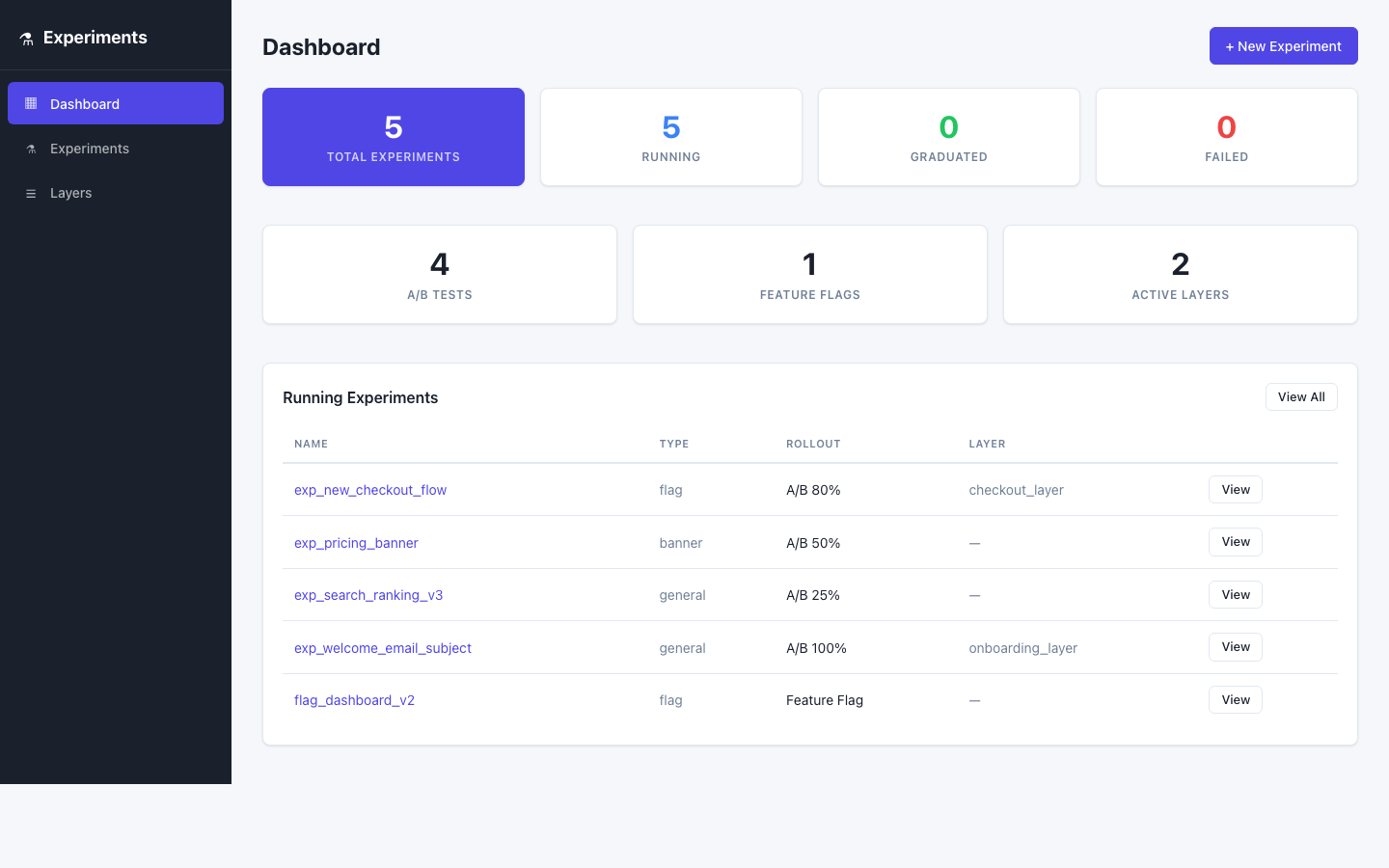
Running / graduated / failed counts, a breakdown of A/B tests vs. feature flags vs. active layers, and a quick-jump table of running experiments.
Experiment list — search, filter, clone
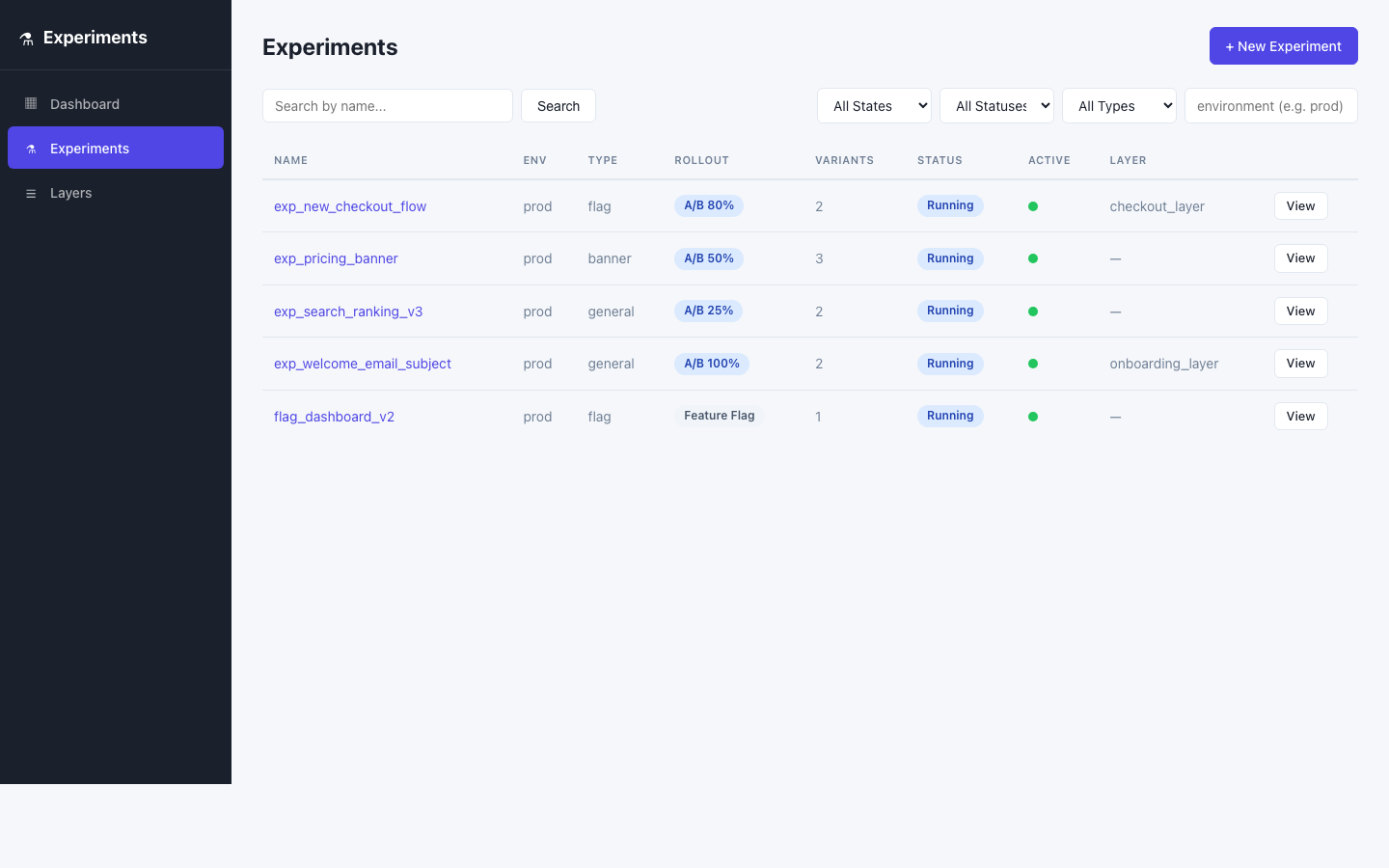
Filter by name, state, status, type, or environment. Rollout, variant count, layer membership and active-state are all visible at a glance.
Experiment detail — variants, targeting, items
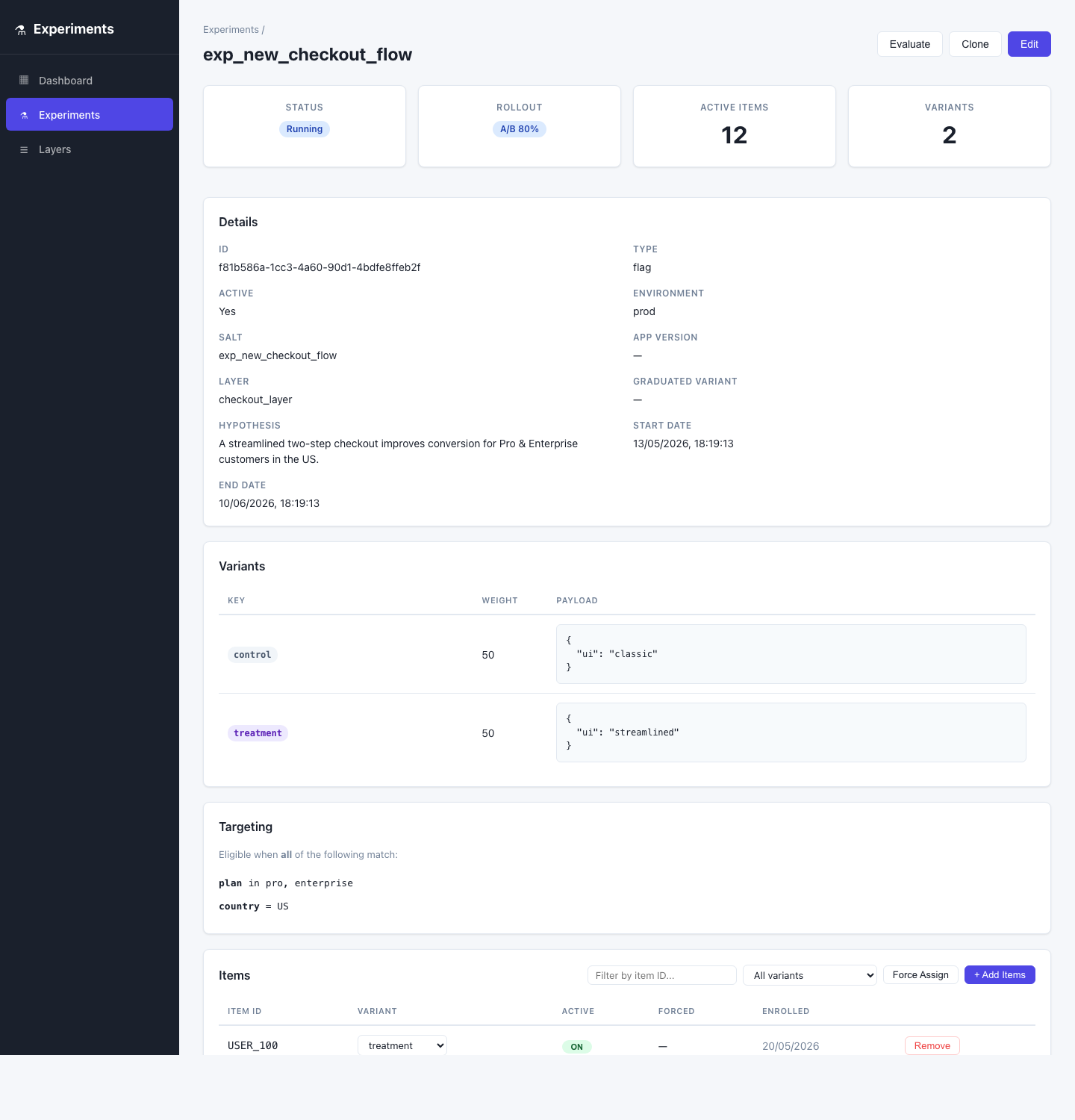
A single page covers everything about an experiment: status, rollout, variant weights & payloads, targeting rules, layer assignment, and the live list of enrolled items — including force-assign and per-item variant overrides.
Experiment form — create or edit
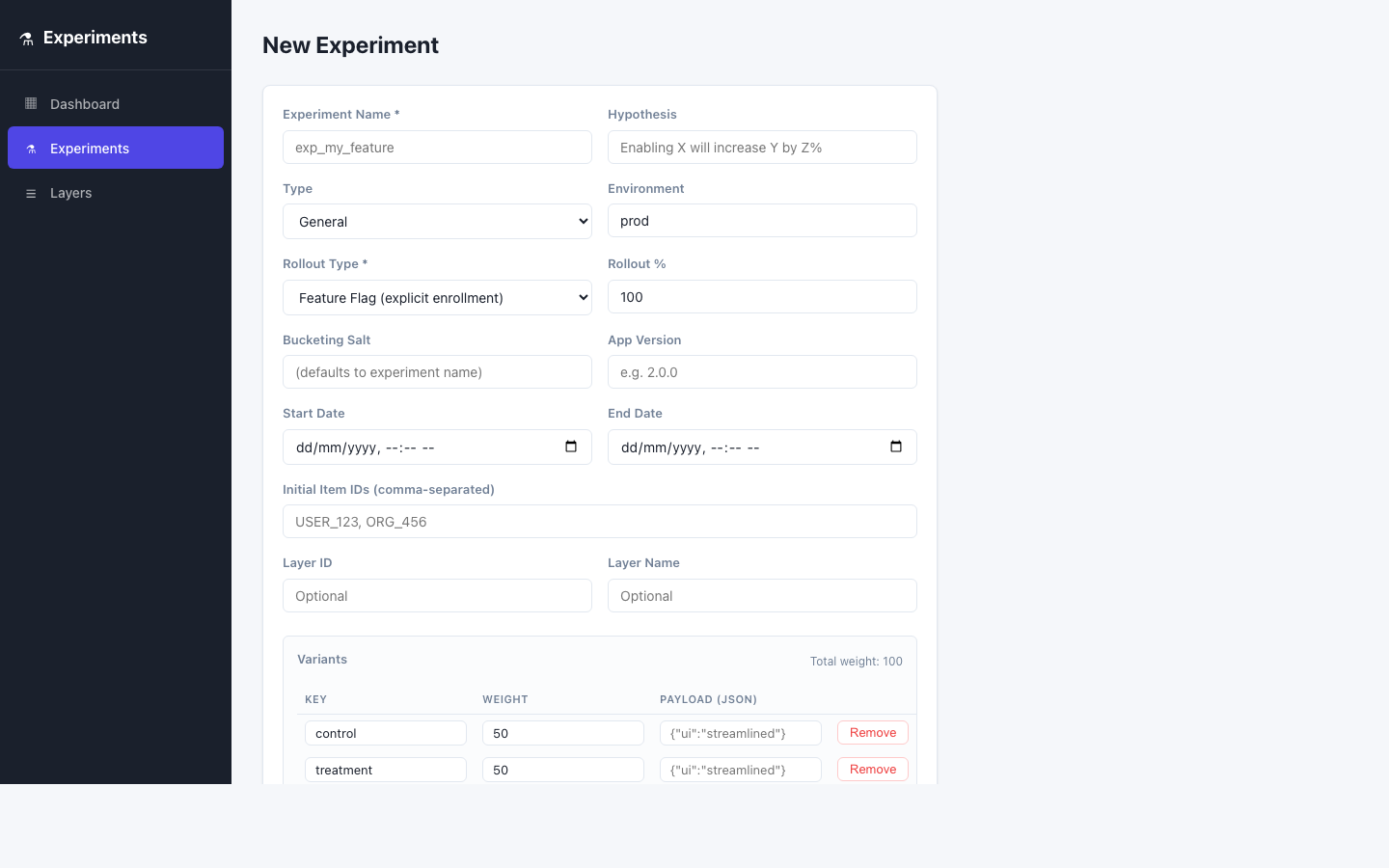
A guided form for setting up new experiments — rollout type, salt, dates, variants with JSON payloads, targeting rules, prerequisites, and layer assignment.
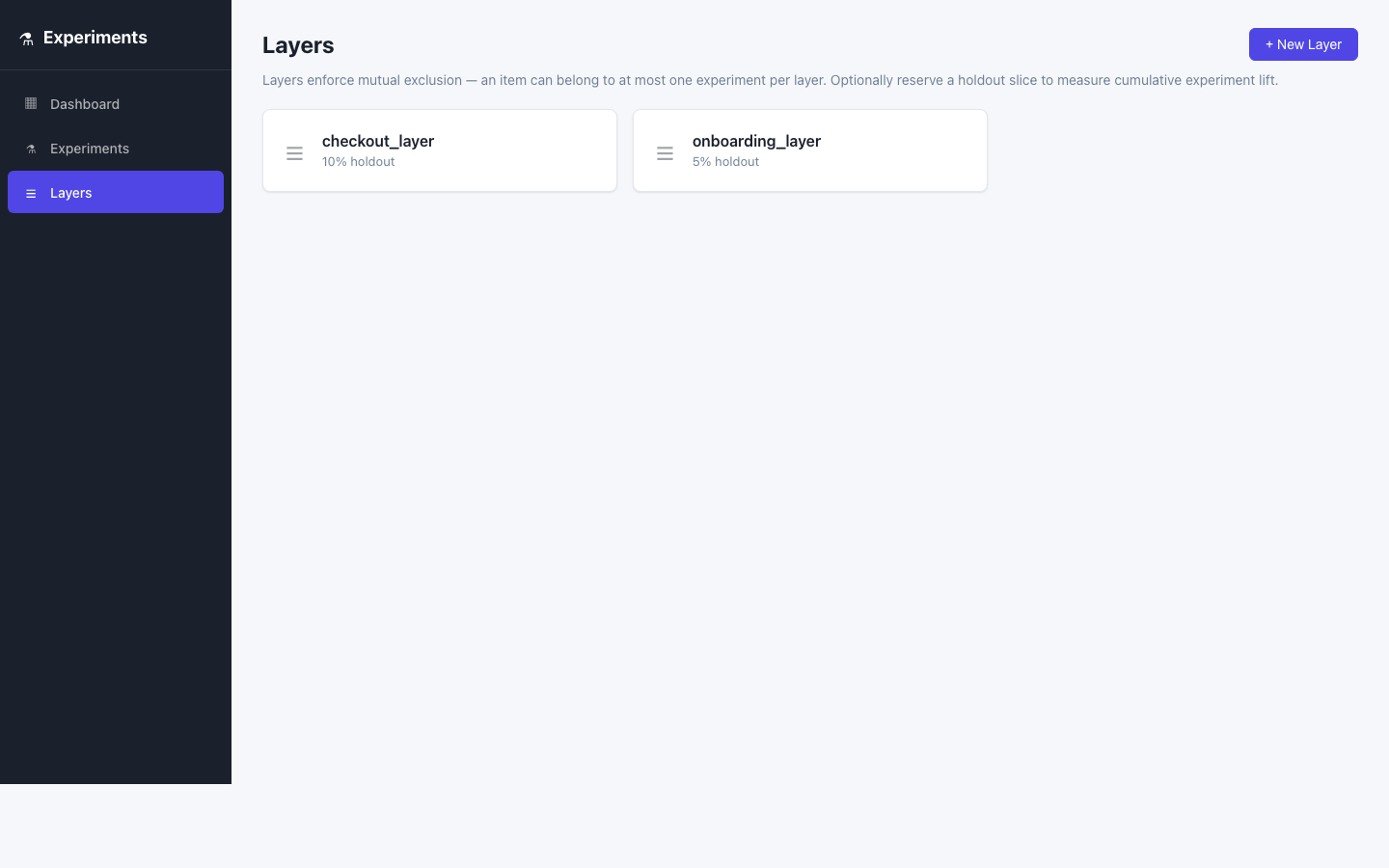
Layers — mutual exclusion + holdout
 |
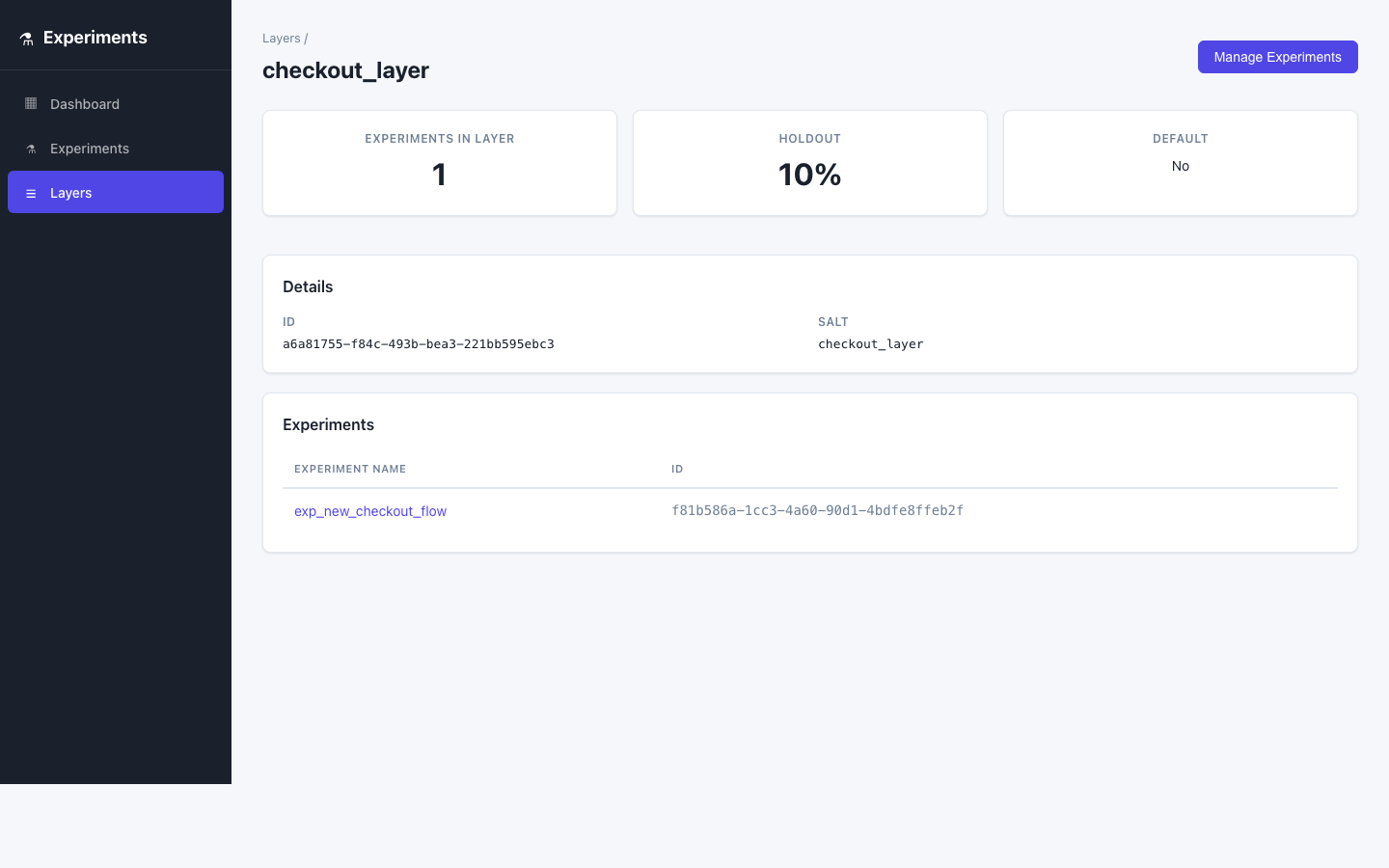 |
Group experiments into a layer to enforce mutual exclusion across audiences. Carve out a global holdout slice so you can measure cumulative lift from everything in the layer.
Quickstart 🚀
1. Install
npm install mendel-framework mongoose
# Optional — only required if you mount the Express admin routes.
npm install celebrate
Requires Node.js ≥ 22 and a reachable MongoDB instance.
2. Initialize
const mongoose = require('mongoose');
const { v4: uuid } = require('uuid');
const { createMendelFramework, ROLL_OUT_TYPE, TARGETING_OP } = require('mendel-framework');

await mongoose.connect(process.env.MONGO_URI);

const { service, manager } = createMendelFramework(mongoose, {
  generateId      : uuid,
  environment     : 'prod',
  cache           : { enabled: true, ttlMs: 5000, max: 1000 },
  persistAudit    : true,
  persistExposure : false,

  onAuditEvent    : (event, payload) => console.log(`[audit] ${event}`, payload),
  onExposure      : (e) => console.log(`[exposure] ${e.exp_name} → ${e.variant_key}`),
});
3. Create an experiment
await service.createExperiment({
  exp_name      : 'exp_new_checkout',
  hypothesis    : 'Streamlined checkout improves conversion for enterprise customers.',
  exp_type      : 'flag',
  roll_out_type : ROLL_OUT_TYPE.A_B_TESTING,
  roll_out_value: 80,                                   // 80% of eligible traffic participates
  variants: [
    { key: 'control',   weight: 50, payload: { ui: 'classic' } },
    { key: 'treatment', weight: 50, payload: { ui: 'streamlined' } },
  ],
  targeting: {
    match: 'all',
    rules: [
      { attribute: 'plan',    op: TARGETING_OP.IN, values: ['pro', 'enterprise'] },
      { attribute: 'country', op: TARGETING_OP.EQ, values: 'US' },
    ],
  },
  start_date: Date.now(),
  end_date  : Date.now() + 30 * 24 * 60 * 60 * 1000,
}, { id: 'admin' });
4. Evaluate flags in application code
const attributes = { plan: 'enterprise', country: 'US', tier: 3 };

// Full evaluation — variant + reason + payload
const result = await service.evaluate('exp_new_checkout', 'USER_42', attributes);
// → { variant: 'treatment', reason: 'bucketed', exp_id: '…', payload: { ui: 'streamlined' } }

// Convenience helpers
const variant   = await service.getVariant('exp_new_checkout', 'USER_42', attributes);
const isEnabled = await service.isEnabled('exp_new_checkout', 'USER_42', attributes);

// Batch lookup for an SDK / mobile client
const config = await manager.getConfigData(['USER_42', 'ORG_7'], attributes);
5. Wire up Express (optional)
const express = require('express');
const {
  express: { ExperimentController, mountRoutes, mountAdminRoutes },
} = require('mendel-framework');

const app = express();
app.use(express.json());

const controller = new ExperimentController({
  experimentService : service,
  experimentManager : manager,
});

const clientRouter = express.Router();
mountRoutes(clientRouter, controller);
app.use('/api/v1', clientRouter);

const adminRouter = express.Router();
mountAdminRoutes(adminRouter, controller, {
  authMiddleware: yourAuthMiddleware,
});
app.use('/api/admin', adminRouter);
See examples/integration.js for the full annotated walk-through.
Run the full stack locally 🐳
docker compose up --build
Brings up:
| Service | URL |
|---|---|
| UI | http://localhost:3100/ |
| Backend | http://localhost:3000/ (proxied through the UI) |
| Mongo | mongodb://localhost:27017/mendel-framework |
Tear down with docker compose down (preserves data) or docker compose down -v (drops the volume).
Seed sample data
For local dev, a seed script ships with the framework that populates Mongo with a representative set of records so the admin UI and the client APIs have something to render right away.
# Defaults to mongodb://127.0.0.1:27017/mendel-framework
npm run seed

# Or point it at a different database
MONGO_URI=mongodb://127.0.0.1:27017/mendel-dev npm run seed
The seeder is idempotent — it deletes the previously seeded records (matched by name) before re-inserting them, so you can re-run it freely.
What it creates:
| Kind | Examples |
|---|---|
| Layers | checkout_layer (10% holdout), growth_layer (5% holdout, default) |
| A/B tests | exp_new_checkout, exp_new_billing (layered & mutually exclusive) |
| Feature flag | flag_dark_mode (explicit per-item enrollment) |
| Banner | banner_summer_sale (targets US / CA / GB) |
| Prerequisite | exp_checkout_upsell (only runs for exp_new_billing#treatment) |
| Graduated | exp_search_relevance (SUCCESS_STATUS.SUCCESS — serves treatment to everyone) |
| Retired | exp_retired_homepage (SUCCESS_STATUS.FAILURE, inactive) |
| Forced items | USER_1..3 pinned to exp_new_checkout#treatment; USER_42, USER_7 to flag_dark_mode#on |
See examples/seed.js for the full payload — copy and tweak it as a starting point for your own fixtures.
Tests
Mendel Framework uses Node.js’s built-in test runner (node:test), so the suite runs with zero extra dependencies and no test framework setup.
npm test
Tests are organised by module and live under test/:
| File | What it covers |
|---|---|
test/bucketing.test.js |
FNV-1a determinism, hashToUnit range, pickVariant weight distribution at N=20k, inRollout / inHoldout independence |
test/targeting.test.js |
Every operator (eq/neq/in/nin/numeric/string/regex/exists), invalid-regex safety, all vs any semantics |
test/cache.test.js |
TTL expiry, capacity-based eviction, cacheKey stability across input ordering & nested objects |
test/service.test.js |
ExperimentService._evaluate decision tree across every EXPOSURE_REASON (NOT_FOUND, ENVIRONMENT_MISS, INACTIVE, NOT_STARTED/ENDED, GRADUATED, TARGETING_MISS, BUCKETED, ROLLOUT_MISS, FORCED, ENROLLED, HOLDOUT), plus audit-hook smoke test |
The service tests use thin in-memory model stubs so the suite runs in well under a second and does not require MongoDB. If you add behaviour that talks to Mongo (e.g. new aggregation pipelines), add an integration test against a real or in-memory Mongo instance — the existing suite intentionally stays at the unit-test layer.
API Reference 📚
createMendelFramework(mongoose, opts)
One-shot factory that wires up models, the ExperimentService (mutations + evaluation), and the ExperimentManager (cached batch reads).
| Option | Type | Default | Notes |
|---|---|---|---|
generateId |
Function |
— | Required. Used to mint document _ids (e.g. uuid.v4). |
environment |
string |
'prod' |
Scopes evaluation to experiments tagged with the same environment. |
cache |
object |
— | { enabled, ttlMs, max } — in-process TTL cache for getConfigData. |
persistAudit |
boolean |
false |
Mirror audit events to ExperimentAudit collection. |
persistExposure |
boolean |
false |
Mirror every evaluation to ExperimentExposure collection. |
onAuditEvent |
Function |
noop | (event, payload) => void — stream to your analytics pipeline. |
onExposure |
Function |
noop | (event) => void — typically forwarded to Segment / Amplitude / BQ. |
onItemsChanged |
Function |
noop | (expName, item, action) => void — side-effects on enrollment. |
Core services
service.createExperiment(data, auditUser)service.updateExperiment(expId, data, auditUser)service.cloneExperiment(expId, overrides, auditUser)service.addItems(expId, itemIds, auditUser, opts)/addItemsBulkservice.removeItem(expId, itemId, auditUser)service.forceAssign(expName, itemId, variantKey, auditUser)service.evaluate(expName, itemId, attributes, opts)— returns{ variant, reason, payload, exp_id }service.getVariant(expName, itemId, attributes)service.isEnabled(expName, itemIdOrIds, attributes)service.assignVariant(expName, itemId, attributes)— probabilistic enrollment + persistservice.createLayer(data, auditUser)/assignToLayer(layerId, expIds, auditUser)manager.getConfigData(itemIds, attributes)— batched lookup with cache
Constants
const {
  EXP_TYPE,         // banner | flag | general
  ROLL_OUT_TYPE,    // A_B_TESTING | FEATURE_FLAG
  SUCCESS_STATUS,   // RUNNING | SUCCESS | FAILURE
  EXPOSURE_REASON,  // not_found | inactive | bucketed | enrolled | targeting_miss | …
  TARGETING_OP,     // eq | in | gt | contains | regex | …
  TARGETING_MATCH,  // all | any
} = require('mendel-framework');
Express routes
| Method | Path | Purpose |
|---|---|---|
GET |
/api/v1/config-data |
Batch evaluation for a list of item IDs |
POST |
/api/v1/evaluate |
Evaluate a single (exp_name, item_id) pair |
POST |
/api/v1/assign-variant |
Probabilistic enrollment + persist |
GET |
/api/admin/experiments |
List / search experiments |
POST |
/api/admin/experiment/setup |
Create experiment |
POST |
/api/admin/experiment/:id |
Update experiment |
POST |
/api/admin/experiment/:id/clone |
Clone experiment |
POST |
/api/admin/experiment/add-items/:id |
Add items to experiment |
POST |
/api/admin/experiment/force-assign |
Pin item → variant |
GET |
/api/admin/layer / /layer/:id |
List / get layers |
POST |
/api/admin/layer |
Create layer |
🧠 How bucketing works
Every variant assignment in Mendel Framework is stateless and deterministic:
bucket = FNV-1a(`${salt}:${item_id}`) / 2^32 ∈ [0, 1)
saltdefaults to the experiment name, but can be customized so two experiments with overlapping audiences don’t share bucket space.- The rollout check uses a separate suffix (
${salt}:rollout) so an item’s eligibility decision is independent of which variant it lands in once eligible. - Holdout selection uses
${layerSalt}:holdout, again independent from variant bucketing.
This means a client SDK with the same hashing logic can evaluate flags identically to the server without round-tripping — perfect for mobile, edge, or SSR.
Contributing 🤝
We love contributions of all sizes — bug reports, feature ideas, docs improvements, and pull requests are all welcome.
Read CONTRIBUTING.md for development setup, branching conventions, commit style, and the PR checklist.
License 📜
Mendel Framework is released under the MIT License.